First-phase rock sampling of archive-generated prospects returns mineralization at surface on all four licenses sampled, including 4.27 g/t Au and 13.9% Zn from outcrop
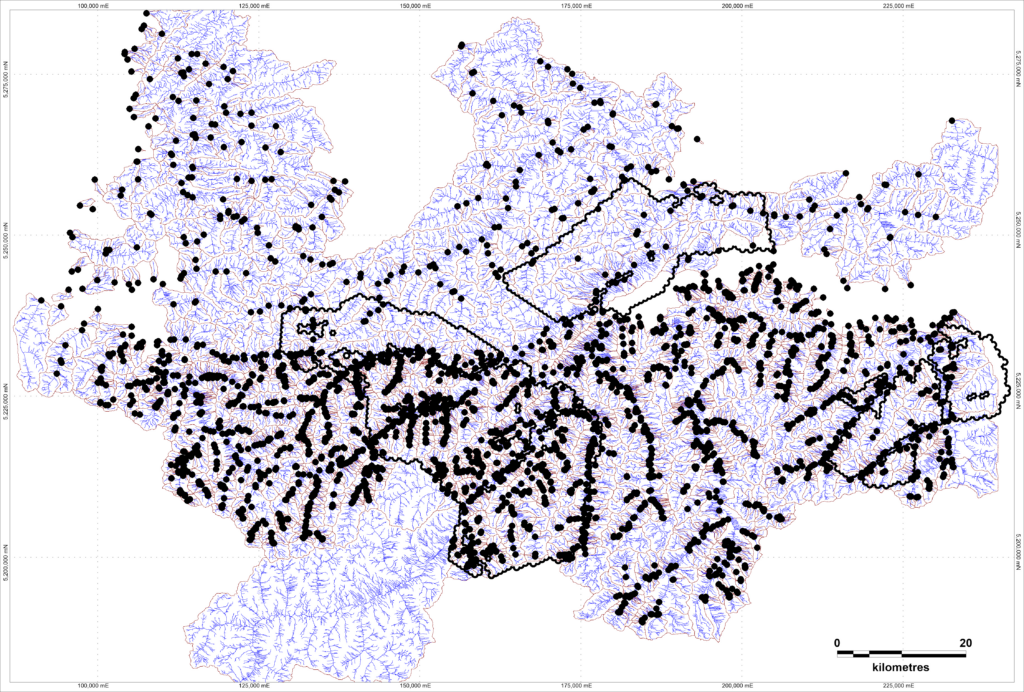
VIENNA, Austria – September 22, 2026 – Ekometall Inc. (“Ekometall” or the “Company”), through its wholly owned subsidiary, Ekometall Exploration GmbH, today announced assay results from the first phase of rock sampling across four of its Austrian license areas, which together cover approximately 4,000 km² of the Company’s more than 10,000 km² land position: Grossfragant (1,233 km², Carinthia), Kelchalpe-Viehhofen (1,775 km², Tyrol and Salzburg), Schwaz-Brixlegg (90 km², Tyrol), and East Tyrol (896 km²). The program was designed to ground-truth exploration prospects generated from the Company’s digitized historical mining archive and returned mineralization at surface on all four licenses sampled.
Highlights
- 298 rock samples assayed to date at ALS Romania, an ISO/IEC 17025-accredited laboratory, ground-truthing prospects generated from the Company’s historical archive. Results for a further 59 samples are pending;
- East Tyrol: Three outcrop samples at Schlossberg returned 4.27, 3.84 and 1.43 g/t Au, each carrying 0.40% to 0.55% Cu. Float sampling at the historic Abfaltersbach workings returned up to 62.3 g/t Ag, 2.13% Pb and 1.90% Sb;
- Grossfragant (Carinthia): Two outcrop samples from a gossanous fault zone at Ladelnig returned 13.9% Zn, and 5.98% Pb, 5.44% Zn and 79.5 g/t Ag, respectively. Float and subcrop samples at Moosalm returned 3.19% and 2.78% Cu, and float sampling at Grakofel returned up to 4.59 g/t Au;
- Schwaz-Brixlegg (Tyrol): Float samples from six historic prospects along the district’s 20 km silver-copper corridor returned between 124 and 392 g/t Ag, including 392 g/t Ag, 3.27% Cu and 0.77% Sb at Falkenstein and 278 g/t Ag and 3.18% Cu at Kaiserbrundl;
- Kelchalpe-Viehhofen (Tyrol / Salzburg): Float samples at Viehhofen South returned 5.36% Cu with 545 ppm Co, and 3.22% Cu with 963 ppm Co, consistent with a copper-cobalt-silver system.
Ryan Finlay, Managing Director and CEO of Ekometall, commented: “The program was designed as an initial ground-truthing and data validation exercise to test exploration prospects generated by the Company’s large-scale historical data scraping campaign. Rock sampling returned high-grade copper, silver, zinc, lead and gold values at surface across all four licenses, confirming that high-grade mineralization is present within Ekometall’s Austrian tenure and that the Company’s proprietary dataset is directing field teams to prospective ground.“
Selected Results
Grossfragant, Carinthia (1,233 km²)
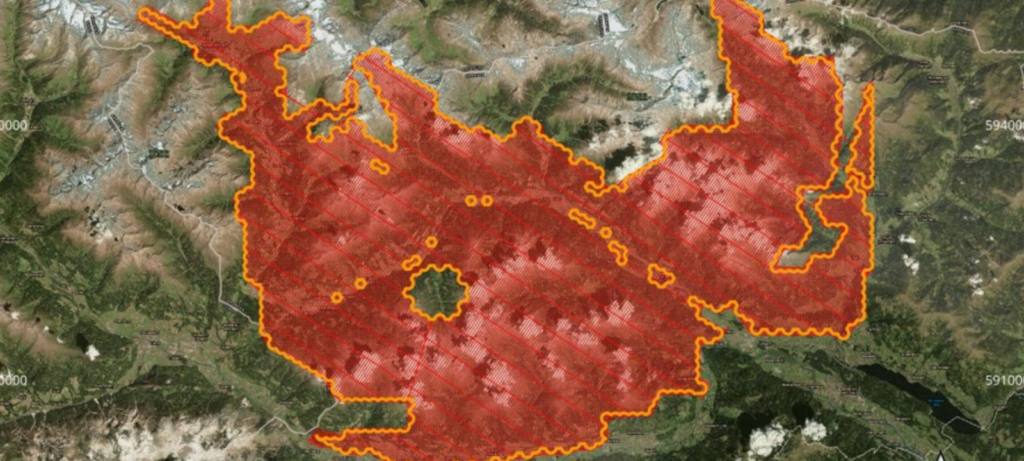
Grossfragant sits within the Penninic units of the eastern Tauern Window, where mineralization occurs as metamorphosed VMS carrying copper-silver-gold and as concordant copper-gold sulfide in greenschist. The strongest base-metal grades were returned from in-situ outcrop at Ladelnig, where the two samples were collected from a gossanous, iron-oxide altered fault zone hosting massive pyrite-pyrrhotite with chalcopyrite and galena. Copper at Moosalm and gold at Grakofel indicate separate copper- and gold-bearing systems within the district. The license is also the subject of the Company’s airborne magnetic and radiometric survey, currently being flown over approximately 1,200 km² of the license area and announced on September 2, 2026.
Sample | Prospect | Type | Cu | Zn | Pb | Ag | Au | Co |
002623 | Ladelnig | Outcrop | 0.56% | 13.9% | 0.13% | 23.0 g/t | 0.05 g/t | 210 ppm |
002622 | Ladelnig | Outcrop | 0.55% | 5.44% | 5.98% | 79.5 g/t | 0.08 g/t | 512 ppm |
002600 | Moosalm | Float | 3.19% | 0.03% | – | 2.1 g/t | 0.15 g/t | 372 ppm |
002614 | Moosalm | Subcrop | 2.78% | 0.05% | – | 2.1 g/t | 0.19 g/t | 262 ppm |
002786 | Grakofel | Float | – | 0.02% | 0.01% | 23.9 g/t | 4.96 g/t | 6 ppm |
002782 | Grakofel | Float | – | 0.05% | 0.03% | 185.0 g/t | 1.44 g/t | 1 ppm |
Schwaz-Brixlegg, Tyrol (90 km²)
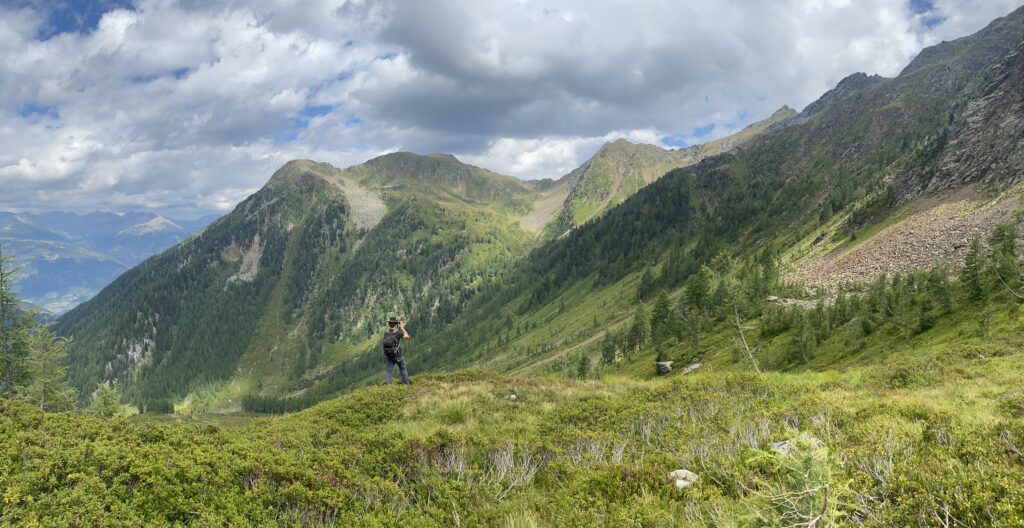
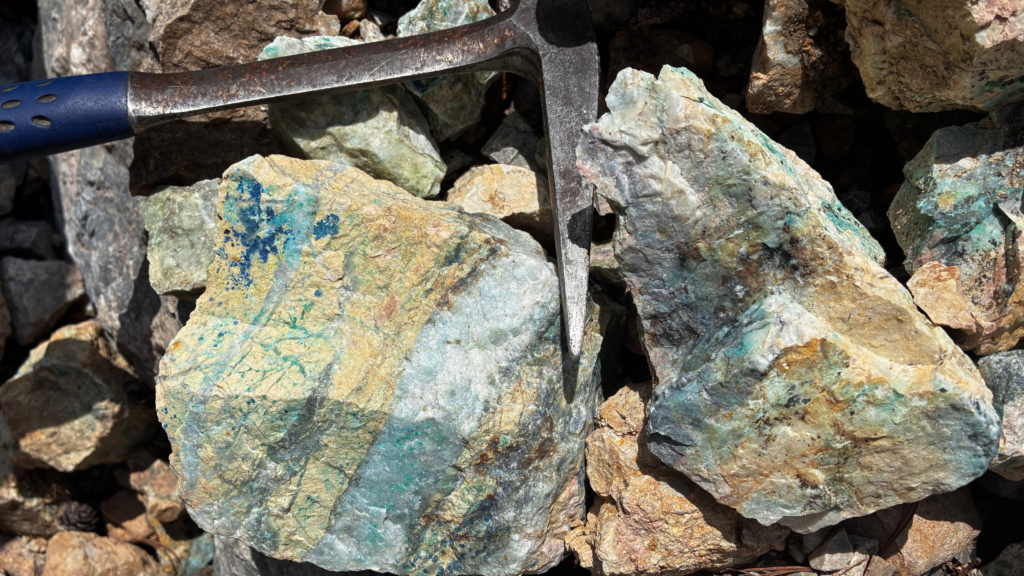
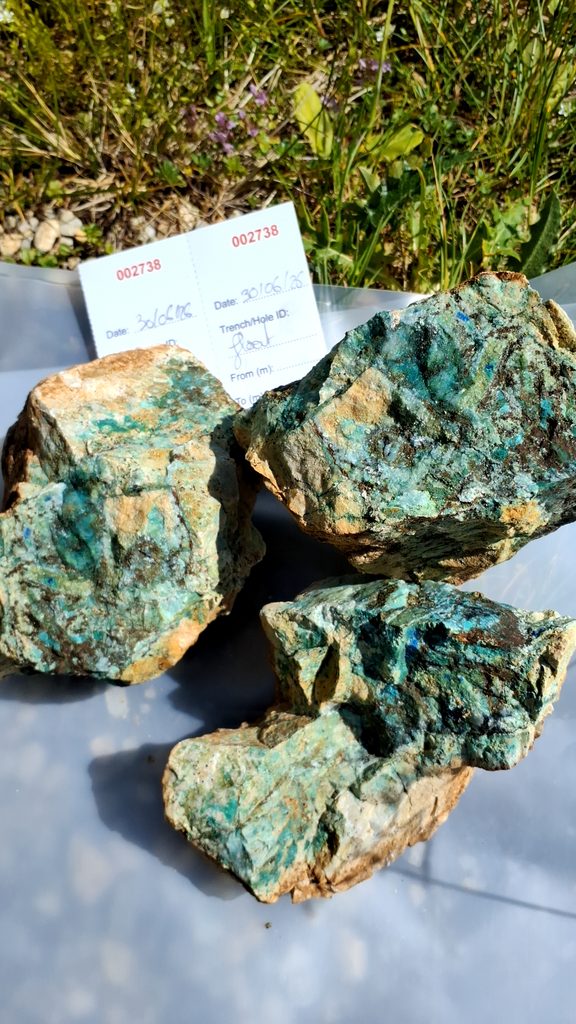
Schwaz-Brixlegg is considered the most prominent historical silver-copper district in the Alps and spans an approximate 20 km, structurally controlled Ag-Cu-Sb corridor hosted in the Lower Devonian Schwaz Dolomite. An initial seven-day reconnaissance and sampling campaign returned high-grade silver and copper values, with field observations describing brecciated, silicified dolomite hosting sulfosalts and chalcopyrite with pervasive supergene malachite and azurite.
Sample | Prospect | Type | Ag | Cu | Sb |
002743 | Falkenstein | Float | 392 g/t | 3.27% | 0.77% |
002738 | Kaiserbrundl | Float | 278 g/t | 3.18% | 0.33% |
002758 | Silberberg | Float | 207 g/t | 2.05% | 0.18% |
002737 | Tiefere Baue | Float | 135 g/t | 1.11% | 0.38% |
002733 | Burgstall | Float | 124 g/t | 1.06% | 0.42% |
002728 | Ringenwechsel | Float | 126 g/t | 0.91% | 0.25% |
Kelchalpe-Viehhofen, Tyrol / Salzburg (1,775 km²)
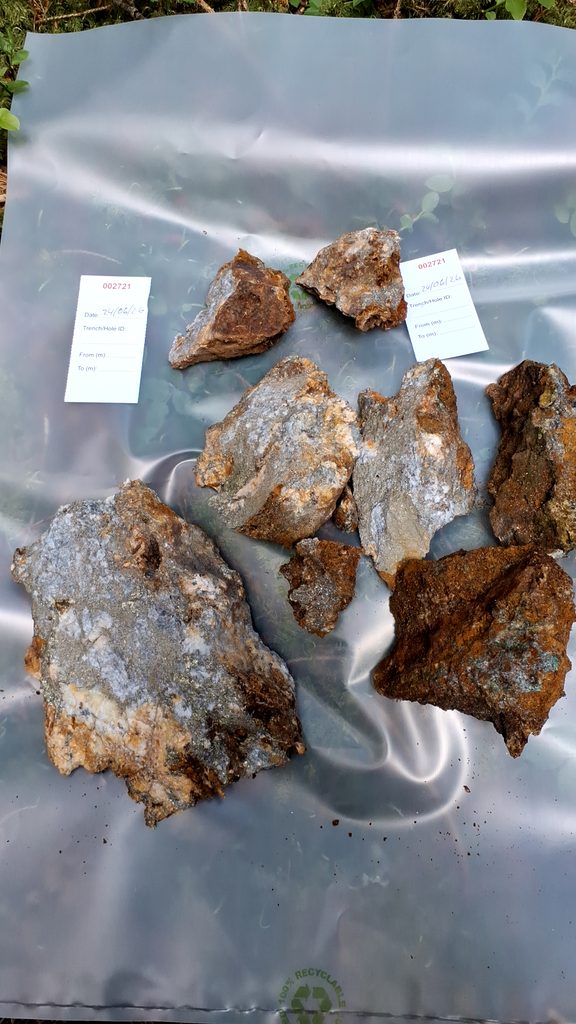
Kelchalpe-Viehhofen lies on the northern margin of the Tauern Window within the Greywacke Zone, where historical mining targeted copper-rich sulphide mineralization hosted in Palaeozoic metasediments and metavolcanics. Float results suggest a coherent copper-cobalt-silver system, with the strongest copper-cobalt values at Viehhofen South.
Sample | Prospect | Type | Cu | Co | Ag | Zn | Au |
002721 | Viehhofen South | Float | 5.36% | 545 ppm | 7.4 g/t | – | 0.07 g/t |
002722 | Viehhofen South | Float | 3.22% | 963 ppm | 8.5 g/t | – | 0.09 g/t |
002717 | Viehhofen South | Float | 4.16% | 117 ppm | 6.7 g/t | – | 0.05 g/t |
002507 | Kelchalpe | Float | 2.99% | 14 ppm | 3.5 g/t | – | 0.24 g/t |
002536 | Mühlbach | Float | 1.95% | 23 ppm | 8.6 g/t | 0.23% | 0.05 g/t |
East Tyrol (896 km²)
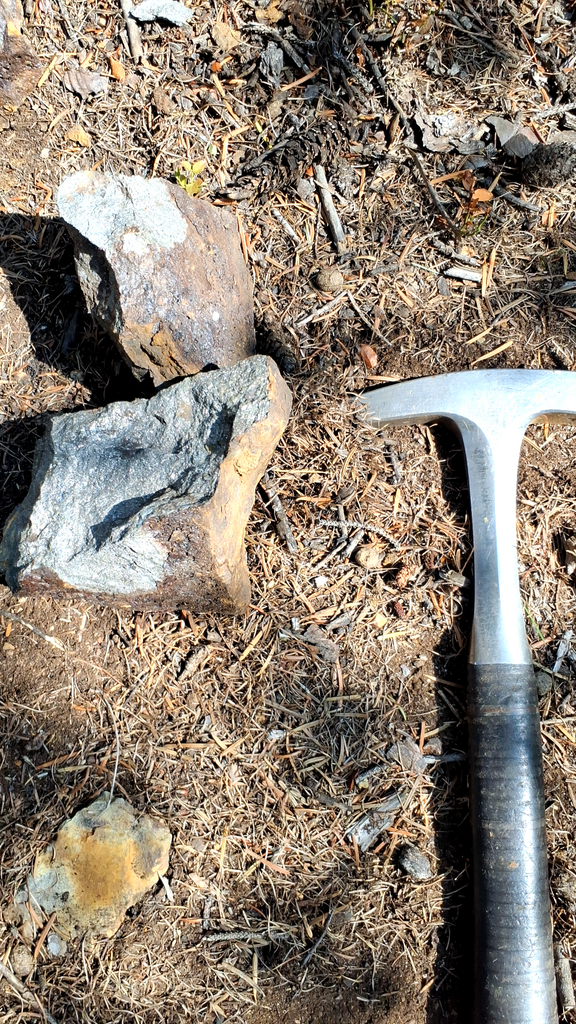
The East Tyrol license sits within the Company’s Drau Project Group along the Drau Range, prospective for polymetallic lead-zinc-copper-silver and gold. A five-day, first-pass reconnaissance program returned high-grade gold with associated copper from three outcrop samples at Schlossberg, together with polymetallic silver-lead-antimony mineralization in float at the historic Abfaltersbach workings.
Sample | Prospect | Type | Au | Ag | Cu | Pb | Sb |
AB-46421 | Schlossberg | Outcrop | 4.27 g/t | 1.4 g/t | 0.41% | – | – |
AB-46418 | Schlossberg | Outcrop | 3.84 g/t | 1.3 g/t | 0.40% | – | – |
AB-46417 | Schlossberg | Outcrop | 1.43 g/t | 1.5 g/t | 0.55% | – | – |
AB-46405 | Abfaltersbach | Float | 0.03 g/t | 62.3 g/t | 0.13% | 2.13% | 1.90% |
AB-46404 | Abfaltersbach | Float | 0.06 g/t | 39.3 g/t | 0.27% | 0.89% | 0.95% |
Next Steps
Assay results for the remaining 59 samples are expected in October. All geochemical results will be incorporated into the Company’s AI-assisted historical intelligence platform, where they will be used to re-rank the exploration hotspots generated from its archive and to prioritize follow-up target generation. The airborne magnetic and radiometric survey currently being flown will provide the structural framework for the Ladelnig, Moosalm, Grakofel, and other Grossfragant prospects, with preliminary processed data expected in Q4 2026.
Sampling, Analytical Method, and Quality Control
Samples were collected by Ekometall field personnel as rock outcrop, subcrop and float grab samples, recorded with handheld GPS and full geological descriptions at the point of collection. All samples were submitted to ALS Romania SRL (Roșia Montană, Alba, Romania), an ISO/IEC 17025-accredited laboratory, under certificates RM26162400, RM26210843, RM26251802 and RM26284496. Samples were prepared by crushing, splitting and pulverizing (ALS codes CRU-31, SPL-22Y, PUL-31) and analyzed by four-acid digestion with a 34-element ICP-AES package (ME-ICP61), with gold by fire assay / AAS (Au-AA25). Over-limit copper, lead, zinc, silver and antimony values were re-assayed by ore-grade methods (ME-OG62 and element-specific OG62 methods). In addition to the laboratory’s internal quality control procedures, the Company implemented its own QA/QC protocol, inserting certified reference materials (standards), blanks, and duplicates into the sample stream to monitor analytical accuracy, contamination, and precision.
About Ekometall
Ekometall is an emerging critical minerals exploration company focused on unlocking Austria’s significant precious and base metal potential across the country’s historic mining districts. The Company has assembled a specialized, Austria-based technical team that applies AI-assisted analysis to digitize and interpret previously inaccessible historical mining and geological records from a mining tradition spanning more than five centuries, transforming archival data into actionable exploration targets.
With a dominant first-mover land position exceeding 10,000 km² and a demonstrated ability to efficiently permit and execute drilling programs, Ekometall offers global mining partners a compelling entry point into a favorable European jurisdiction. The Company’s combination of local expertise, modern exploration methods, and extensive mineral tenure establishes Ekometall as the essential gateway for accessing the critical raw materials vital to Europe’s energy transition and industrial future.
For more information, visit ekometallgroup.com.
For more information on Ekometall’s projects or for investor relations inquiries, please contact:

Ryan Finlay
Managing Director & CEO
Cautionary Note
As a privately held company, Ekometall is not a reporting issuer under National Instrument 43-101, the JORC Code or any other recognized mineral reporting standard, and the technical information in this release has not been reviewed or verified by an independent Qualified Person. Readers should not rely on the results as compliant with, or reported under, any such standard.
Grab, float, and rock-chip samples are selective by nature and are collected to test for the presence of mineralization. The samples reported here are not necessarily representative of the mineralization across the sampled zones or the project areas as a whole, and reported grades should not be interpreted as indicative of average or continuous grades at any prospect. Float samples in particular reflect transported material and do not confirm the location of an in-situ source. Individual high-grade results, including those highlighted in this release, may not be representative of a mineralized body. No estimate of any mineral resource has been made, and the results reported do not represent a mineral resource or mineral reserve. Substantial additional exploration, including systematic sampling, mapping, geophysics and drilling, would be required before any assessment of economic potential could be made, and there is no assurance that such work would define a mineral resource.